
What Is a Strategic Plan?
A strategic plan is a clear roadmap for where you're going, why it matters, and how you'll get there. It goes beyond annual budgets or high-level mission statements. A true strategic plan connects your vision to action—from the big picture down to the next step on the ground.
At The Barzel Group, we help leadership teams create plans that don't collect dust. That means breaking things down into practical, usable parts that align your people and move your organization forward.
Whether you're leading a business, nonprofit, or team within a larger org, your strategic plan should answer these questions:
- Where are we now?
- Where are we going?
- How will we get there?
- What's next?
If your current plan doesn't make that clear, you're in the right place.

Why Most Strategic Plans Fail (And How Yours Won’t)
Ever seen a beautiful strategic plan slide deck collect dust for 11 months? Yeah, us too.
One of our clients had what looked like a great plan. Slick graphics. Clear goals. Even a mission statement everyone agreed on. But when we met again a year later, they hadn’t looked at the thing since their retreat.
A strategic plan that just sits on a shelf isn’t a strategy. It’s a suggestion.
If you want your team to move in the same direction—and stay accountable along the way—you need more than a good-looking plan. You need a process. One that helps you:

That’s what this page is for.

TL;DR: What Every Strategic Plan Needs

Know where you are (Perspective)

Make execution visible and accountable

Define where you’re going (Vision + Mission)

Review every 90 days

Set SMART goals and track progress
Want a worksheet version?
The 8 Components of a Strategic Plan
1. Perspective
Before you map out the future, you need to be honest about where you are. Like Google Maps, you can’t get directions without a starting point.
At The Barzel Group, we often start planning sessions with tools like:
- SWOT (but we call it Breakthrough, Battle, Frustration, Failure)
- The Four Helpful Lists (What’s Right? Wrong? Missing? Confused?)
- These give us a realistic snapshot so we’re solving the right problems.
2. A Clear Vision
Your vision should paint a picture of the future. Think Walt Disney walking people through Main Street USA before it was ever built.
If your team can’t imagine the end goal, they won’t work toward it. Vision gives people something to believe in and aim for.
3. A Defined Mission
Where vision shows the destination, mission explains the vehicle. Why do you exist? What are you doing, and for whom?
Starbucks nails it: “To inspire and nurture the human spirit—one person, one cup, and one neighborhood at a time.”
Your mission should ground your daily decisions.
4. Core Values
Core values are more than wall art. They’re the rules of engagement for your team, clients, and vendors.
Patrick Lencioni puts it best: Values clarify identity and give people a rallying point. They also give you language to make the hard decisions.
5. Goals & Objectives
Here’s where we go from vision to traction. Goals and objectives make the abstract actionable.
These should be:
- Specific
- Measurable
- Attainable
- Relevant
- Time-based (SMART)
Use hard numbers: revenue targets, contracts, margin growth, etc.
6. Performance Drivers & Risks
Performance drivers are the elements that move the needle. These might be:
- Order cycle times
- Product development speed
- Employee retention
- Customer satisfaction
Risks are the unknowns that can derail progress. Identifying them upfront helps you make backup plans before you need them.
7. Action Plan
Knowing what to do is great. Doing it? That’s where the magic happens.
Every plan needs clear next steps. In StratOp, we call them AIPs (Action Initiative Plans). Each one should have:
- A name
- An owner
- A team
- A deadline
- Defined deliverables
Without this, plans become wish lists.
8. Quarterly Review
Accountability is everything. If you don’t review your progress, it’s easy to get distracted, discouraged, or off track.
High-performing teams make space every 90 days to:
- Revisit the plan
- Assess progress
- Adjust priorities
When review becomes rhythm, execution follows.
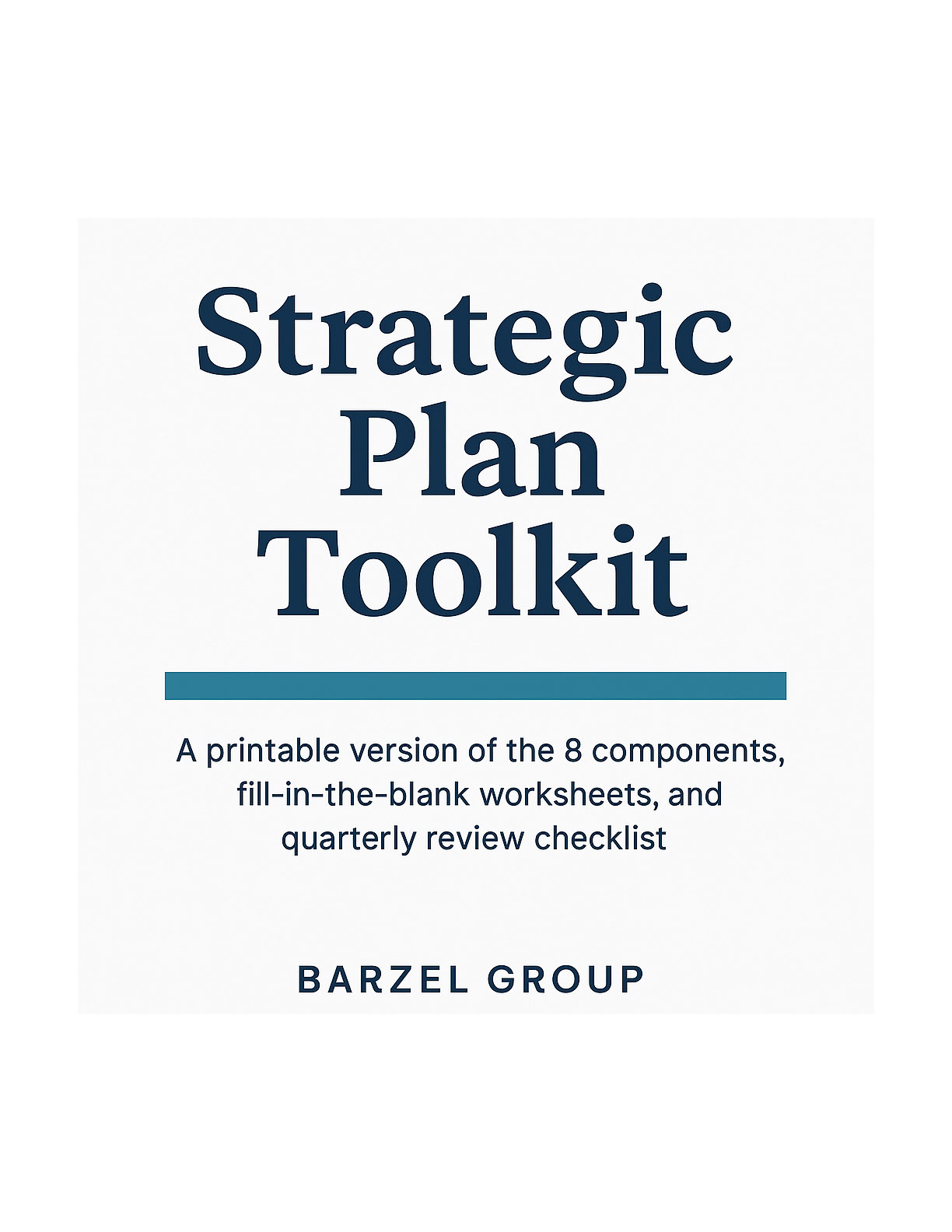
Download the Strategic Plan Toolkit
Want to walk through this process with your team? Grab our free Strategic Plan Toolkit. You’ll get:
Who This Framework Is For

CEOs and leadership teams
EOS®/StratOp users

Department
heads

Nonprofit
boards

Business coaches and consultants
If you want more alignment and better execution, this framework will help you get there.
FAQs
There are eight core elements: Perspective, Vision, Mission, Core Values, Goals & Objectives, Performance Drivers & Risks, an Action Plan, and a Quarterly Review rhythm. Each one supports alignment, execution, and long-term focus.
Your vision is where you're going—your desired future. Your mission is how you plan to get there—what you do, for whom, and why it matters.
EOS is a full operating system. This framework is a front-end strategic process that can feed into EOS or stand on its own. In fact, many of our clients use this framework to inform or strengthen their EOS implementation.
Most teams can build their plan in 2–3 days of focused work. After that, we recommend quarterly 2-hour reviews to stay aligned and accountable.
That’s great. Use this framework to pressure test it. You may find what’s missing, outdated, or not actually being used.
Typically, your leadership team and the people responsible for executing the work. Cross-functional input helps surface blind spots and drive alignment.
Not at all. We’ve used this process with churches, schools, nonprofits, and boards. If you lead a team, this can help you plan for the future.
Want Help Building Yours?
Schedule a no-pressure, 30-minute call to talk through where you are and what kind of help (if any) makes sense.
Or, if you want ongoing support and accountability, check out our mastermind group: